


About Dan Duggan
Dan Duggan, 55, was provisionally arrested by the Australian Federal Police on 21 October 2022 in Orange, NSW, after a request by the United States government.
He is now in maximum security, solitary confinement in a NSW prison at Lithgow.
Dan has never been charged or convicted of any crime in Australia. We believe that the charges against him in the US are false and politically motivated. He has been singled out for unknown reasons.
During his detention he has unnecessarily faced the harshest treatment.
He was not allowed in the exercise yard, and has been locked up with terrorists, rapists and others convicted of heinous crimes.
Dan has not been provided the reasons for his “segregation” in prison, by the Australian Federal Police or by the NSW Commissioner of Corrective Services.
Dan is a wonderful father, husband, friend and a model Australian citizen. Importantly, Dan has been a sole Australian citizen since 26 January 2012 and has called Australia his home since 2002.
Dan’s case is a test of Australian sovereignty that is being fought by a struggling farming family in regional NSW at great personal and financial expense. The family is shocked at what the Australian Government has done to them and appeal for your support.
Dan is a veteran pilot and the unwitting victim of a geo-political storm between the United States and China – the same imaginary war that has recently seen the Australian government commit $400 billion to AUKUS nuclear submarines.
“It seems to us, undoubtedly, that this indictment was brought about at a time when the US administration was entering into a geopolitical contest with China, and was seeking to use the criminal law in furtherance of US foreign policy,” Dennis Miralis solicitor.
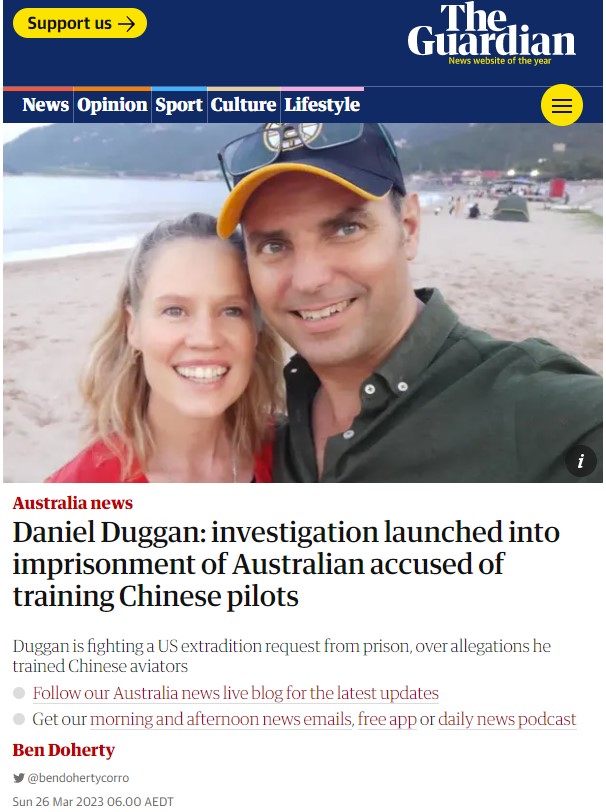
Dan was arrested so that the United States could make an extradition request to the Australian Attorney-General, Mark Dreyfus. He has the power to free Dan.
This is a politically motivated case based on a 2017 indictment in the US, that was cobbled together and secretly filed away.
Dan is caught in a geo-political storm for working with Chinese people. He is accused of training Chinese military pilots in South Africa in 2012, which he completely denies.
His unfair treatment has resulted in formal complaints to the United Nations Human Rights Committee and the Inspector-General of Intelligence and Security, which was under investigation.
The Inspector-General of Intelligence and Security launched an Inquiry into the matter, with full Royal Commission powers.
“The manner and circumstances behind this prosecution of Dan are something you would expect to find in an authoritarian country, but not in a democratic Australia where its citizens expect a more fair and balanced equal application of the law and the overriding principle of a ‘fair go’ for all.
“Our family has been shattered by this experience and we urge the Australian Attorney-General Mark Dreyfus and the Albanese government to do the right thing and release Dan.
“My children simply don’t understand what is happening to their loving father, and I firmly believe that Australians will not stand for outrageous interference by the United States in our country.
“Our large family is facing huge expenses, including legal bills, a living costs, and a campaign to raise awareness. I am struggling to put food on the table and pay the bills – but we will fight on, no matter what.”
A test pilot is a pilot who flies new or modified aircraft that may be still under development, such as new passenger planes or even jumbo jets. The purpose of the tests is to determine if the aircraft is safe, operates as expected and meets aircraft regulations. Since these planes may not yet be approved for regular use and may still need modifications, or may have undergone significant alterations since being in use, test pilots need to understand how to assess the performance of the craft, how to identify mechanical issues, and they take risks by flying these aircraft.[1]
“It takes a certain fearlessness to fly and evaluate experimental or newly-modified aircraft. The brave individuals who become test pilots do just that: they fly those aircraft and test new technologies.” Smithsonian National Air and Space Museum.[2]
Airlines such as Boeing hire test pilots to evaluate the performance of their aircraft. Test pilots play a vital role in ensuring that technologies and aircraft are safe for their passengers and pilots.
In the United States, the National Test Pilot School (NTPS) located in California, is the largest civilian training centre for test pilots in the world. The mission of NTPS is to educate and train aviation personnel so that “each graduate increases flight test competency, improves flight test and aviation safety, and enhances the aerospace profession worldwide.”
Many test pilot trainers come out of the U.S. Air Force. The test pilot instructors at NTPS also come from a range of other backgrounds, including two who served in the Italian Navy and an Australian who spent 15 years in the RAAF.
There are a number of other civilian test pilot schools throughout the world, including the International Test Pilots School (ITPS) located in Canada, The Euro Flight Test located in Germany and The Test Flying Academy of South Africa (TFASA).
TFASA are the Test Flying Academy of South Africa. TFASA provides training to test pilots, flight test engineers, and basic operational instructor pilots under closely controlled security conditions. All training aspects and material are strictly unclassified, and provided either from open source or the clients themselves. No training involves classified tactics or other information, nor any frontline activities.
“TFASA highlights that the training it provides is also available from other civilian contractors including organisations based in the United States of America, Australia, United Kingdom, Canada, New Zealand, and European jurisdictions.”
After the indictment of Dan, TFASA stated this: “TFASA has operated with the full knowledge of NATO defence and security agencies for over a decade. Recent communications between the US Federal Bureau of Investigation and the US Air Force Office of Special Investigation and the Society of Experimental Test Pilots indicate that TFASA has broken no laws.”
The indictment of Daniel Duggan references TFASA as a co-conspirator, along with 7 other co-conspirators. Despite the Grand Jury being sworn in November 2016, so far, no other charges in relation to the alleged actions have been laid.
The training as stated by Dan and by TFASA is that any training of these pilots included only publicly available or open-source information.
The indictment of Dan calls into question rights to use our skills in different contexts. Because he trained in the military, does that mean that he is not allowed to use or even discuss his piloting skills anywhere else?